You walked past the front desk this morning and saw it before anyone said anything. Gaps in the hygiene column. A hole at 2:00 that nobody filled. The phone that used to ring four or five times before lunch has rung twice.
And the thought starts: something is wrong.
Maybe your dental website stopped working. Maybe Google dropped us. Maybe the ads are burning money. Maybe the new person up front is not converting calls. Maybe the practice across town is running something we do not know about. Maybe patients just do not have the money right now.
If you have run any of those loops at 11pm, you are in good company. We hear a version of this conversation every July, and the honest answer usually surprises doctors: most of the time, nothing broke. You are sitting in the most predictable slow stretch of the dental calendar. But “usually” is not “always,” and you deserve a real way to tell the difference instead of a reassuring pat on the back.
So let us do that. First, why summer does this to practices. Then, how to actually check whether your marketing is the problem.
Everybody Is on Vacation, Including Your Patients
The simplest explanation is usually the right one. Summer scatters everyone.
School lets out and families leave town. Grandparents fly in. Kids go to camp. The patient who was ready in April to finally do the implant is now three days from a road trip and does not want to schedule anything until they are back. Your hygienist is out the week of the Fourth. You took a long weekend yourself, and honestly, you needed it.
None of that is a marketing failure. That is human beings living their lives in July.

There is a money piece too, and it is not the one dentists usually assume. Vacations, camps, and travel are competing for the exact dollars a patient might have put toward veneers or Invisalign. It is not that they decided against treatment. It is that August is loud and expensive, and the smile makeover moved down the list until the fall.
Then there is insurance, which is quietly the biggest lever in the whole year. Most dental plans reset January 1 with a use-it-or-lose-it deadline on December 31. Sit down with a calendar and look at where July falls. It is the farthest point from both deadlines. Nothing is expiring. Nothing has just reset. The two moments that create real urgency to book are both about as far away as they can get. That is not a coincidence in your schedule. That is the shape of the year.
The Slowdown Is Not Hitting Everything Equally
Here is the part worth paying attention to, because it changes what you should do next.
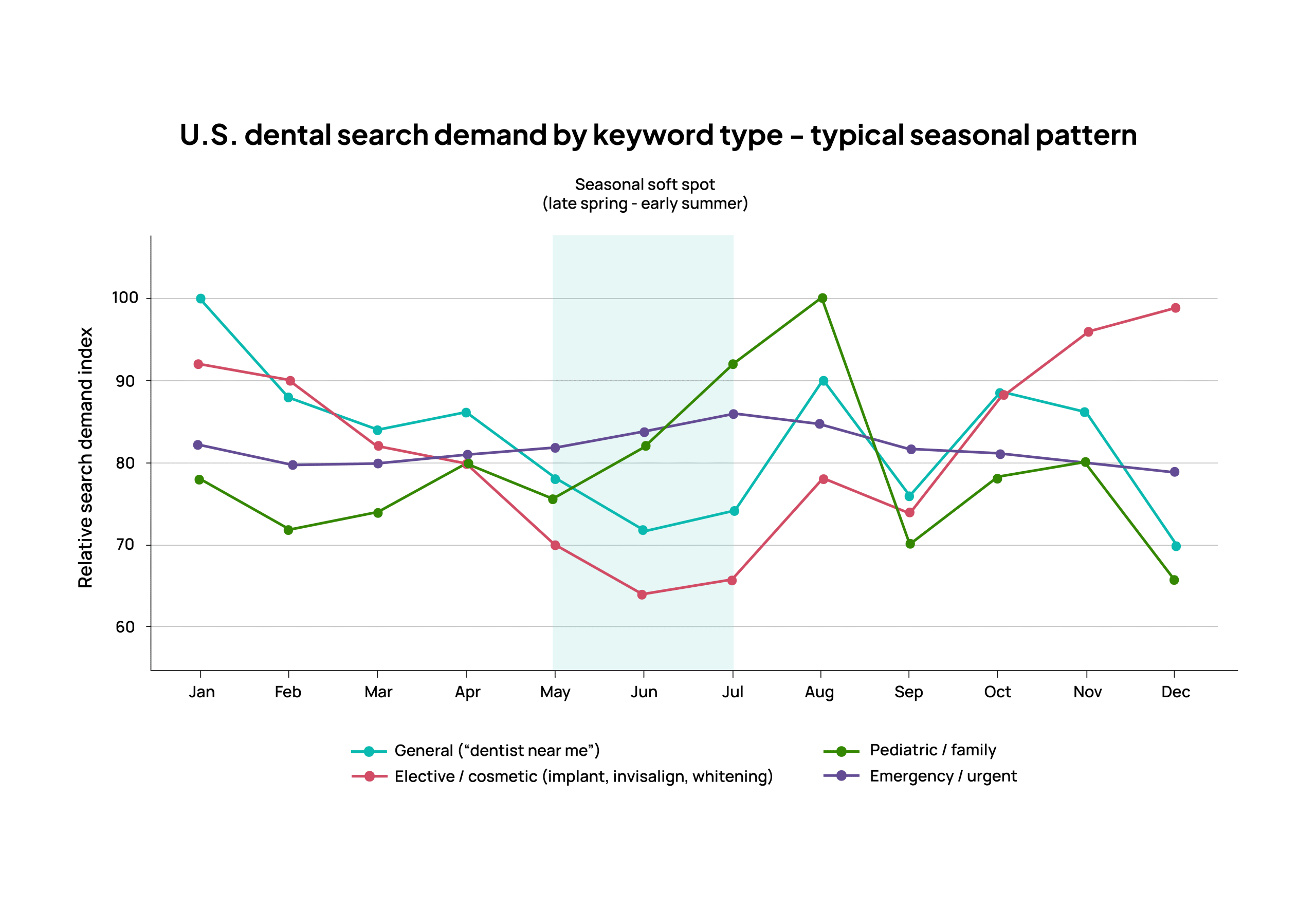
When a doctor tells us “everything is down,” the numbers almost never agree. Demand splits by what the patient wants, and the three groups move in completely different directions right now.
Elective and cosmetic interest is genuinely soft. Implants, Invisalign, whitening, veneers, and general “dentist near me” searching all cool off from late spring into midsummer. If your practice leans cosmetic, you are feeling this the hardest, and you are feeling it at the same time as everyone else in your market.
Emergency demand does not move. Toothaches do not take vacations. Urgent searches hold steady straight through the summer, which is why the practices with strong emergency visibility barely notice the dip.
Family and pediatric demand is climbing right now. Parents are starting to think about back-to-school checkups, and that demand builds through late July and peaks in August. Orthodontic starts follow the same pattern, because families want treatment underway before the school year.
So the accurate read is not “everything is down.” It is that one category is soft, one is flat, and one is about to spike. That is a message and timing problem, not a broken-marketing problem.
How to Tell If It Is You or If It Is July
This is the question underneath all the others, so let us be direct about it. There is a real difference between seasonal softness and a marketing problem, and you can tell them apart. Here is how we work through it with a practice.
Compare to last July, not to last month. This is the single most common mistake. Of course you are down from March. Everyone is down from March. The only comparison that means anything is the same month last year and the year before. If you are down 15% from June but flat against last July, your marketing is doing its job and the season is doing its thing.
Separate impressions from clicks from calls. These three numbers tell three different stories, and lumping them together hides the answer. If people are still finding you and still clicking through but fewer are calling, that is not a visibility problem. That is intent softening, which is exactly what summer looks like. If impressions themselves fell off a cliff, now you have something real to investigate in your search engine optimization or your Google Ads account.
Check whether your rankings actually moved. Dentists assume a ranking drop far more often than one happens. Pull the actual keyword positions. If you are still holding page one for your core terms, your SEO is intact and fewer people are simply searching. If you genuinely slipped, that is a different conversation and a fixable one.
Look at what happens after the click. Sometimes the leads are arriving and dying quietly. Is your dental website loading fast on a phone? Is the contact form working, or has it been silently failing since a plugin update? How long does it take someone at the front desk to call back a form submission? A practice can have healthy traffic and still bleed patients in the ninety seconds after someone reaches out.
Check your Google Ads for the right problem. When a dentist says “my Google Ads are not working,” the fix depends on which number moved. Falling impressions is a budget or competition issue. Steady clicks with fewer conversions is a landing page or offer issue. Rising cost per click with the same volume is a bidding issue. Same symptom, three different causes, and guessing wrong wastes a month.
If you go through those five and everything looks normal against last year, you have your answer. The slowdown is the season, not your strategy.
How We Actually Answer This for Practices
We work only with dental practices, and we have been doing it since 2007. That means when a doctor calls in July worried about a soft month, we are not guessing. We can look at what is happening across our clients and across the market, and we can look at that practice’s own history to see whether this July looks like their last July.
The tool that makes that possible is {{{{link id=’73082′ text=’ProView Analytics, our reporting platform. If you are not a client yet, here is what it does in plain terms: it pulls your website traffic, your search rankings, your Google Ads performance, your phone calls, and your form submissions into one place, then ties them to actual patient inquiries rather than vanity metrics. We only count real inquiries. Not spam form fills, not thirty-second wrong numbers, not every button click an ad platform wants to call a conversion.
That matters most in a month like this one, because it turns an anxious question into a factual one. Instead of “I think we’re slow,” you get “calls are down 12% from June and up 4% against last July, organic traffic is flat, and the ads are converting at the same rate for less money than they did in April.” One of those keeps you up at night. The other one tells you what to do Monday morning.
You can also run your own rough version of this math with our dental marketing ROI calculator if you want a starting point before talking to anyone.
The Worst Thing You Can Do Right Now Is Go Quiet
Every summer, some percentage of practices look at a soft month and cut their marketing budget. It feels responsible. It is the most expensive decision you can make in July, for two reasons.
The first is competitive. When other practices pull their ad budgets in summer, there is less competition for the same clicks, which often means your ads cost less than they did in the spring. The practices that stay visible are buying attention at a discount from the ones who left.
The second is momentum. Search engine optimization and content do not switch on when you need them. If you go dark in July and turn everything back on in September, you are starting cold in the exact month you needed to already be winning. The practices that show up in the back-to-school and year-end waves are the ones that never stopped showing up.
Point Your Message at Where the Demand Actually Is
You do not need to spend more this month. You need to say something different.
Right now, lead into the demand that is holding or climbing. Family and back-to-school checkups are building week by week toward August, so that message should already be live on your website, in your ads, and on your Google Business Profile. Emergency and same-day care never softened, and if a competitor is outranking you for urgent terms, that is steady year-round volume you are handing away. Cosmetic consultations still convert in summer if you tie them to a reason, because fall weddings, reunions, and holiday photos are close enough now to motivate someone who has been thinking about whitening since spring.
Then start setting up your fall, because here is the number that should shape it: only about 3% of patients ever use their full dental benefits. A 2024 ADA Health Policy Institute analysis found that just 3.4% of patients reach the typical annual maximum, with another 3.3% coming within $100 of it. Most plans cap between $1,000 and $2,000 and reset every January 1, which means an enormous amount of benefit money quietly expires every December 31.
That is the most persuasive thing you can say to a patient in the fall, and the practices that win Q4 start saying it in late August, not in the November flood when every practice in town sends the same email.
Your Slow Month Has a Date on the Other End
The dip you are in right now is not open-ended, and that is the part worth holding onto. Family and pediatric demand peaks in August. The year-end benefits rush builds through October and December. January is the single biggest new patient month of the year, every year, when New Year resolutions collide with fresh insurance benefits.
Three waves, all of them on the calendar, all of them coming. The only question is whether your practice is visible when they arrive.
If you want a straight answer about whether your slowdown is seasonal or structural, that is a conversation we are happy to have. We will look at your actual numbers against your own history and tell you what we see, including if the answer is that nothing is wrong. Book a call with Pro Impressions Marketing and let us take a look together. Call us today at (970) 672-1212 to get started.